
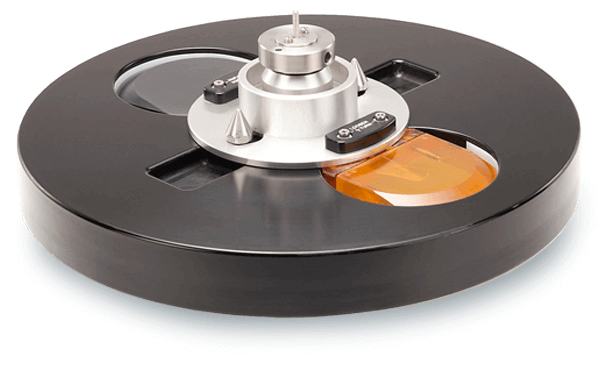
エルトリエータロータ
エルトリエータロータは、単独の細胞または微小粒子(直径:約2~50 µm)の単分散懸濁液を、サイズにより分離および/または濃縮するようデザインされています。エルトリエータロータは2通りの分離技術を兼ね備えており、チャンバー内の各細胞は、以下に挙げる2つの相反する力によって移動します。
- 遠心力:回転軸から遠ざかる方向に働きます。これは遠心力が影響する場における、沈殿のプロセスです。
- 流速:回転軸に向かって働く、「対向流によるエルトリエーション」です。これは「押し流し」による分離のプロセスです。
分離は、じょうご形のエルトリエーション・チャンバー内で行われます。ロータの遠心回転中に、細胞懸濁液は設定された流速で、遠心機外からロータ内の、エルトリエーション・チャンバーの細くなった終端へ圧送されます。浮遊細胞がチャンバー内に導かれると、その沈降係数に応じて、勾配を形成する2つの力の効果が釣り合う位置まで移動します。
沈降係数の低い小型の細胞は、回転軸方向に速やかに押し流されます。この細胞はチャンバーから押し流され、ロータを上って回収容器に排出されます。より大型の細胞や密度の高い細胞は、より時間を掛けてチャンバー内を移動し、エルトリエーション境界の、遠心力と対向流の平衡位置に達します。サイズや密度が最も高い細胞は、チャンバー注入口近傍の、遠心力と対向流の速度の高い平衡位置に留まります。段階的に流速を上げることにより、サイズや密度が徐々に増す、連続的な分画が洗い出され、これを回収することができます。流速を上げ続けることにより、最終的にはすべての細胞について、チャンバーからのエルトリエーションが達成されることになります。
エルトリエータロータの使用目的と仕組みの詳細はこちら
FAQ on Elutriation Rotors
How does an elutriation rotor work?
An elutriation rotor contains a specialized chamber in which cells are exposed to opposing centrifugal and fluid-flow forces. Smaller cells are carried out of the chamber more readily, while larger or denser cells remain until flow conditions change. This enables sequential collection of distinct cell populations.
What is counterflow centrifugal elutriation?
Counterflow centrifugal elutriation is a separation method in which fluid is pumped toward the center of a spinning rotor while centrifugal force drives particles outward. The balance between these opposing forces allows cells to be separated according to size and sedimentation behavior.
How are cells separated during centrifugal elutriation?
During centrifugal elutriation, cells are exposed to two opposing forces: centrifugal force, which drives cells away from the axis of rotation, and fluid flow, which pushes them in the opposite direction. Cells separate according to their size and sedimentation behavior. Smaller cells are elutriated first, while larger or denser cells remain in the chamber until higher flow rates are applied.
What is elutriation?
Elutriation is a separation technique that uses opposing fluid flow and centrifugal force to separate particles or cells according to their size and sedimentation properties. Unlike pelleting-based methods, elutriation enables continuous fractionation of cell populations while helping maintain cell viability.
What is centrifugal elutriation?
Centrifugal elutriation is a laboratory technique that combines centrifugation and controlled fluid flow within an elutriation chamber. Cells or particles separate based on their size and sedimentation rate as fluid moves against the centrifugal field.
What applications are elutriation rotors commonly used for?
Elutriation rotors are commonly used for cell fractionation, immune cell isolation, stem cell research, cell enrichment, cell therapy development, and other applications requiring gentle separation of viable cells.
What is the difference between elutriation and conventional centrifugation?
Conventional centrifugation typically separates particles by pelleting them within a tube. Elutriation separates cells continuously using opposing fluid flow and centrifugal force, enabling collection of distinct populations while minimizing cell stress and supporting higher cell viability.
What are the advantages of centrifugal elutriation?
Centrifugal elutriation can support gentle cell processing, high recovery rates, scalable workflows, and reproducible fractionation of cell populations. It is commonly used when viable cells must be isolated without labeling or extensive sample manipulation.
Why is elutriation used for cell separation?
Elutriation enables label-free separation of viable cells based on physical properties such as size and sedimentation rate. This makes it useful for applications where maintaining cell integrity and functionality is important.
